
Rolling Meadows Previous Resident Sources
Rolling Meadows previous residents appear across sources with different clocks. CookViewer confirms the current parcel and preserves map context from 2000 forward. Clerk recordings carry the ownership trail into the digital and microfilm eras. Haines volumes and the 1955 suburban phone book add address-to-name snapshots, while permits, census schedules, newspapers, and obituaries can test whether a person was connected with the place. No one source establishes every person who lived there.
| Source | Years It Covers | Where Held | What It Shows |
|---|---|---|---|
| CookViewer parcels | 2000-current archive | Cook County GIS | PIN, geometry, address, and map context |
| Clerk digital recordings | 1985-present | CRS and Clerk Room 120 | Deeds, transfers, mortgages, releases, and liens |
| Older deed books and microfilm | 1871-1984 | Cook County Clerk and archives | Earlier grantor and grantee chains |
| Haines criss-cross volumes | 1979-present guide coverage | Arlington Heights Library | Dated address-to-name snapshots |
| Chicago Suburban phone book | June 1955 | Library of Congress | Name, street, locality, and telephone |
| Census, permits, and news files | Source-dependent | Libraries, archives, and city offices | Household and construction context |
Begin with the current PIN even when the question concerns the 1950s. It gives the legal parcel key needed for the recording index. Then choose the source closest to the target date. For a modern transfer, use CRS and obtain the instrument. For a mid-century household, test the directory and census trail. For a gap before digital recording, contact the Clerk or archives rather than treating the blank screen as a blank history.
Pin the Rolling Meadows Address
Enter the exact street and unit in CookViewer, verify the result on the map, and copy its 14-digit PIN. Save the municipality, township, parcel class, and assessment date too. A Rolling Meadows mailing address often returns Palatine Township because the township is tax geography, not the city or postal label. Both fields can be correct.
Keep three values separate: the situs address is the parcel's physical location, the tax mailing address is where a bill goes, and the legal description or PIN identifies the land in county records. A current PIN is a bridge, not proof that an old street label or parcel shape was identical. CookViewer's historic parcel archive starts around 2000, leaving a much older city-development era to be bridged with deeds, plats, permits, and directories.
Process: address to CookViewer parcel, parcel to PIN, PIN to Clerk index, instrument date to the next prior party.
Sort Rolling Meadows Deeds Backward
The Cook County Clerk Recordings System should be searched by PIN first. Save every relevant index row and sort by recording date. For each instrument, capture the grantor, grantee, document type, document number, recording date, legal detail, and image or copy status. The live index showed documents through August 6, 2026 when researched, but that moving cutoff does not mean every document class or image is sold online.
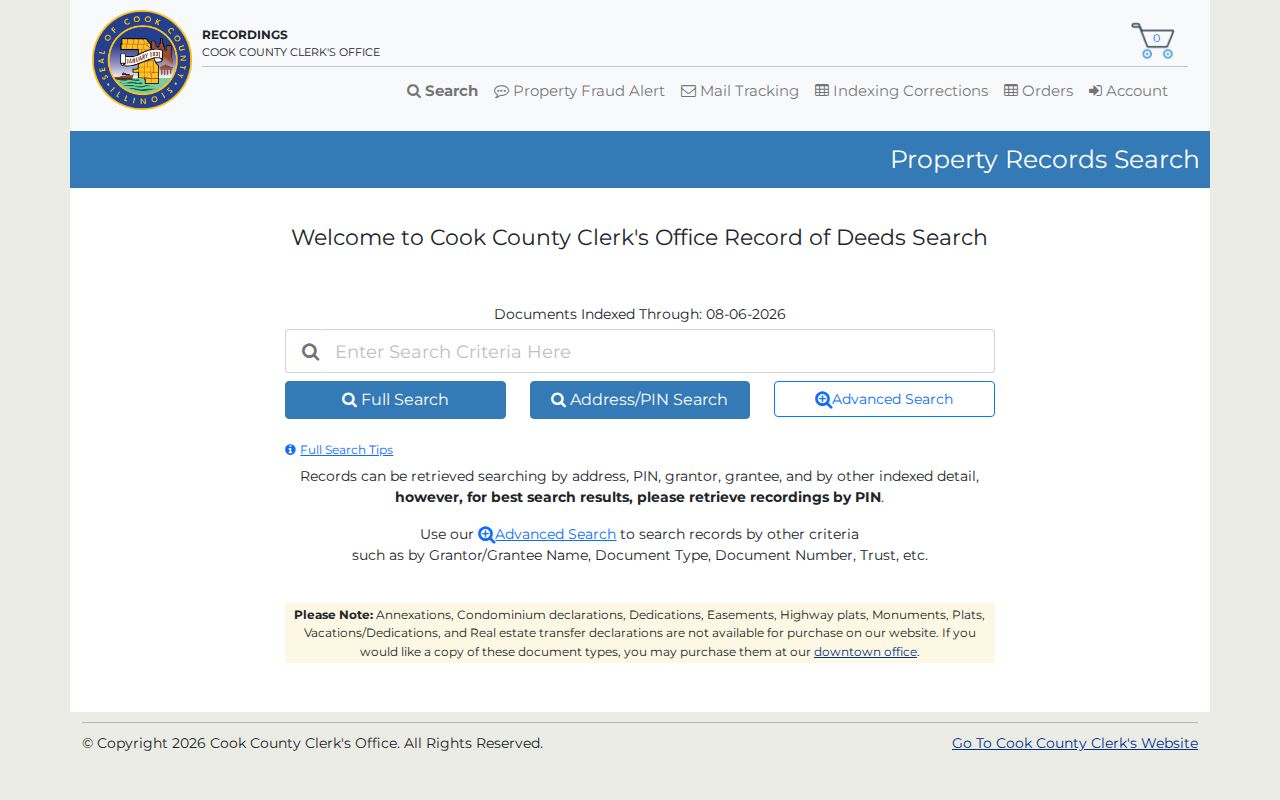
The basic index supplies the dated links needed to start a chain without claiming that a deed party occupied the address.
The advanced recording search adds grantor, grantee, document type, date, trust, subdivision, and legal-description paths.
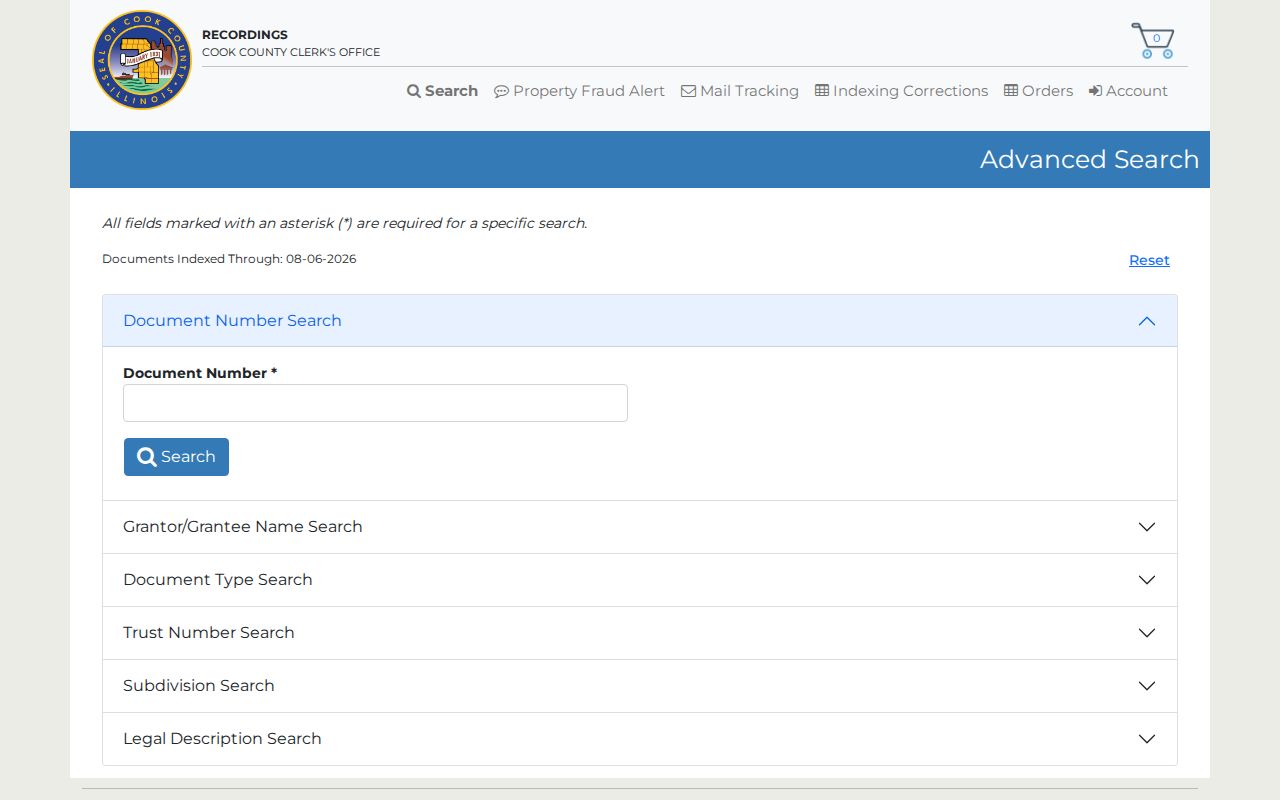
Use those fields after the PIN search reveals a party name, and preserve the selected role in the research notes.
Trace Cook County Ownership Backward
A chain of title is the linked sequence of recorded interests in one parcel. Start from the newest deed shown for the PIN, not from an assumed current occupant. The grantee is the party receiving the interest, and the grantor is the party giving it. Search the prior grantor in the role and date range suggested by the instrument, then inspect related deeds and releases. Names alone are risky, especially when trusts, estates, and businesses appear.
- Confirm the parcel address and PIN in CookViewer, then compare the Assessor and tax portal fields.
- Find the newest transfer instrument in CRS and save its document number, type, date, and parties.
- Search the seller as an earlier grantee, using the PIN and legal description to reject same-name results.
- Repeat the dated chain. Note trusts, estates, liens, mortgages, and releases as distinct roles.
- When the digital trail ends, request the older book, microfilm, or certified copy from the Clerk or archives.
- Grantor / grantee
- The grantor gives or conveys an interest; the grantee receives it.
- Chain of title
- The linked series of recorded interests affecting the same parcel.
- Legal description
- The land description used in instruments. It can remain useful when a street name or number changes.
A mortgage or release documents financing, not a move. A quitclaim deed can transfer an interest without a standard sale, and a transfer-on-death instrument may take effect later. Read the actual document before stating what changed.
Rolling Meadows Records Before 1985
Digital recordings cover 1985 forward. Earlier Cook County deed material sits in books, duplicate sets, and microfilm. Records from 1871 through 1959 can involve duplicate or off-site books, while relevant 1959 through 1985 series use original microfilm. Some older acetate film has vinegar-syndrome deterioration. The October 9, 1871 Chicago fire also explains gaps and reconstructed county material.
The FamilySearch Cook County deed catalog describes about 837 reels covering roughly 1872 through 1886. Online and affiliate access varies.
The catalog is a route to older evidence, not a promise that each image has been indexed by name.
For recordings, call 312-603-5050, email clerk.recordings@cookcountyclerkil.gov, or use the Clerk's Room 120 counter. IRAD at Northeastern Illinois University accepts focused mail or phone requests at 773-442-4506. Ask for an existing index entry, book, instrument, or microfilm series with the names, date range, PIN, and legal description.
Read Rolling Meadows Document Roles
Previous residents cannot be inferred from a document label alone. A warranty deed, quitclaim deed, mortgage, release, trust deed, lien, judgment, and transfer-on-death instrument each records a different legal event. A grantee may be a trust. A permit applicant may be a contractor or agent. The tax mailing address may belong to a bill recipient elsewhere.
Record the role exactly as shown. Use phrases such as “appears as grantee in the instrument recorded on this date” rather than “lived there.” An address-based directory or census can then test household presence. That separation is vital in Rolling Meadows, where parcel, postal, township, and municipal labels overlap without meaning the same thing.
Key point. Search the PIN before the name, then carry the same PIN into CRS and the county tax portal.
Date Rolling Meadows Subdivisions First
A subdivision date can expose a false match. The first Kimball Hill homes were built in 1953, and Rolling Meadows incorporated in 1955. Creekside Association describes 109 homes developed from 1968 through 1972. Tall Oaks and Dawngate appear in later city planning material. An address assigned to a later phase cannot belong unchanged in an earlier directory.
The 1950s House at 3100 Central Road preserves the 1953 Laurel model and local documents. Treat it as historical context, not as a resident list. Search the builder, model, subdivision, street, plat, and newspaper date before joining an old address to a modern PIN. This is the bridge between Rolling Meadows's early development clock and CookViewer's parcel archive beginning around 2000.
Rolling Meadows Permits Date Changes
City permit and inspection files can date construction, additions, demolition, and address-linked projects. Search Rolling Meadows Community Development records by the exact address or PIN. Preserve owner, agent, applicant, and contractor as separate fields. If the Customer Self Service route does not expose an older file, submit a narrow Illinois Freedom of Information Act request for an existing permit, inspection, attachment, or address record.
The ordinary city FOIA response period is five business days, with a possible five-business-day extension. The city may redact private data and does not have to create a new roster. Ask for a defined address, PIN, project, and date span. A permit can help establish when a structure changed, but the applicant's name does not by itself identify every occupant.
Match Rolling Meadows Past Households
Recorded owners are only one layer. Use the June 1955 Chicago Suburban telephone book and the Haines criss-cross coverage reported from 1979 forward to test who was published at an address. Search the street-number section first, then confirm the name in alphabetical pages. Preserve Rolling Meadows, Palatine Township, Chicago Suburban, or the exchange exactly as printed. The collections and reading method are detailed on the Rolling Meadows city directory page.
Pair a directory snapshot with the nearest available census year through HeritageQuest, Ancestry Library Edition, or FamilySearch. Then use HeritageHub obituaries, local newspaper files, probate records, and vital genealogy routes for dated family links. An obituary is a secondary lead, not a death certificate. A census is an enumeration on one date, not proof of residence across the decade.
- Save the directory year, page, locality, name, and exact address.
- Check the closest available census schedule and retain its enumeration details.
- Compare deed and permit dates without treating their parties as household members.
- Use obituary or probate evidence to test a departure, death, or estate transfer.
The Arlington Heights house-history workflow shows how nearby library sources fit this kind of search.
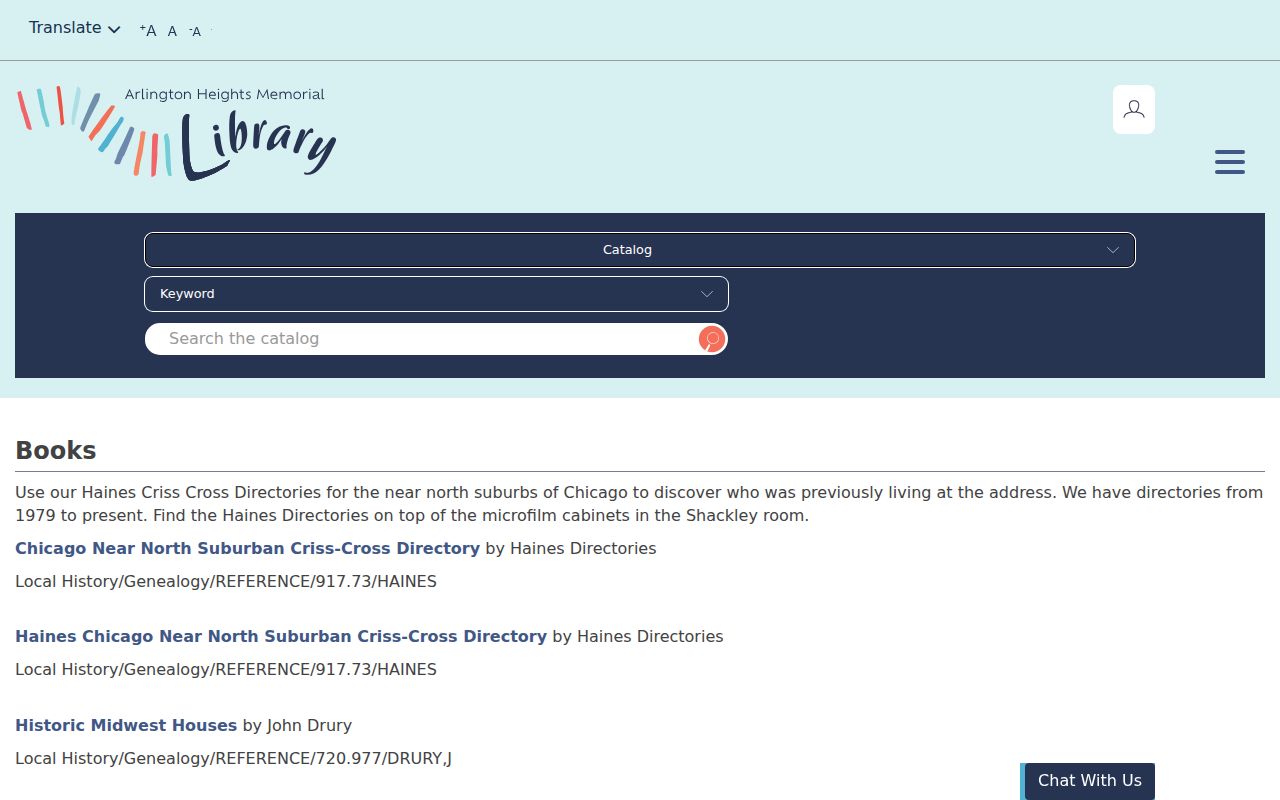
Its sequence reinforces the need to compare assessor, Clerk, census, directory, and newspaper evidence rather than relying on one name.
Lawful use. Research Rolling Meadows previous residents for family or house history, and never use a record to track, stalk, harass, or harm a living person.
Explain Rolling Meadows Record Gaps
A missing result is evidence about access, not proof that no event occurred. A directory year may be absent, the city may be indexed under a nearby label, an old deed image may not be online, or fire and film damage may affect the county series. Keep a gap log with the source, date range, search terms, and fallback tried.
For a hard case, contact three custodians in order: Rolling Meadows Community Development or the City Clerk for an address-specific permit file, Cook County Clerk Recordings for PIN index rows and copy status, then Rolling Meadows or Arlington Heights library staff for the matching directory, census, or newspaper year. Include both old and current address strings and the subdivision name. State only what the dated chain proves.